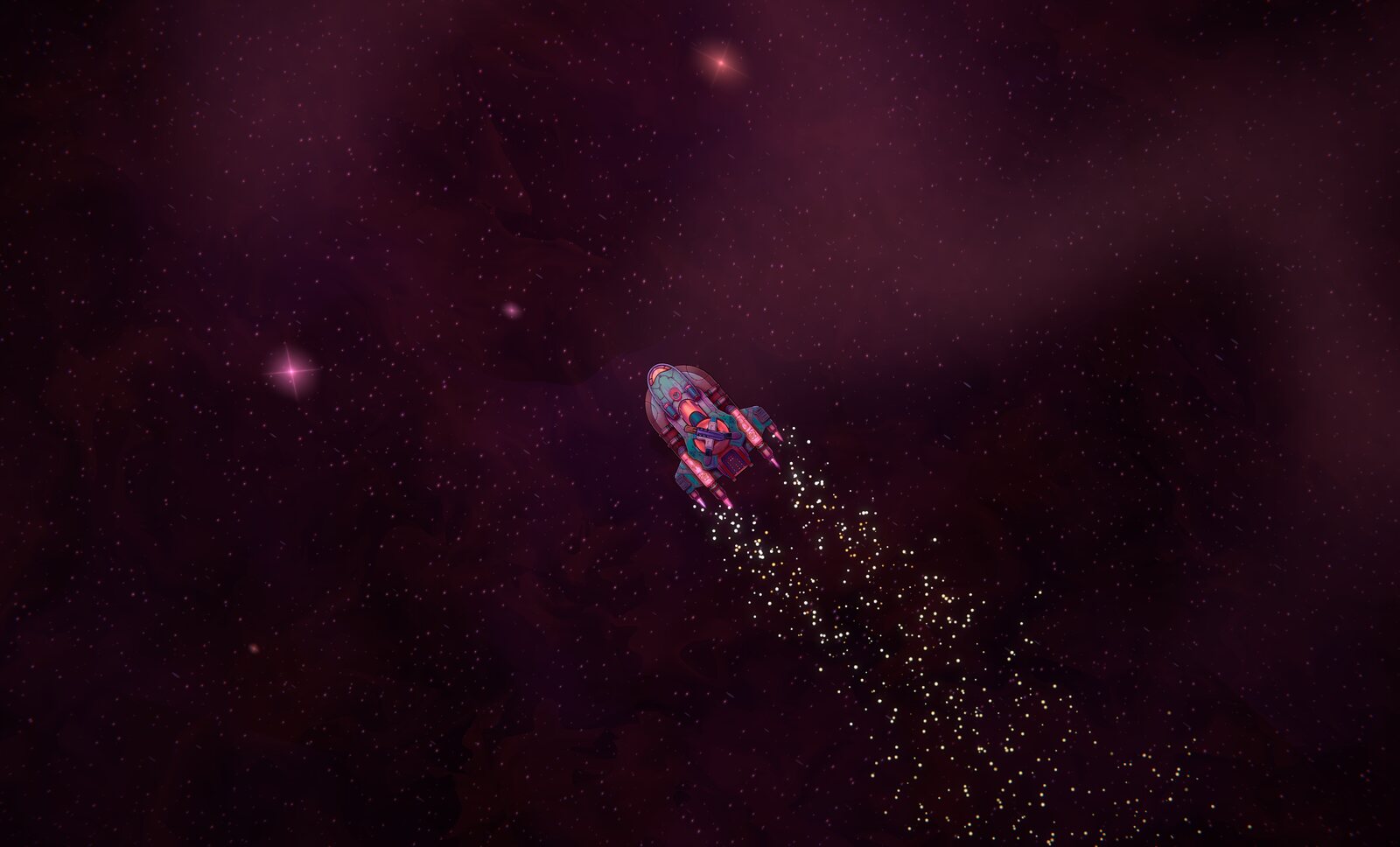
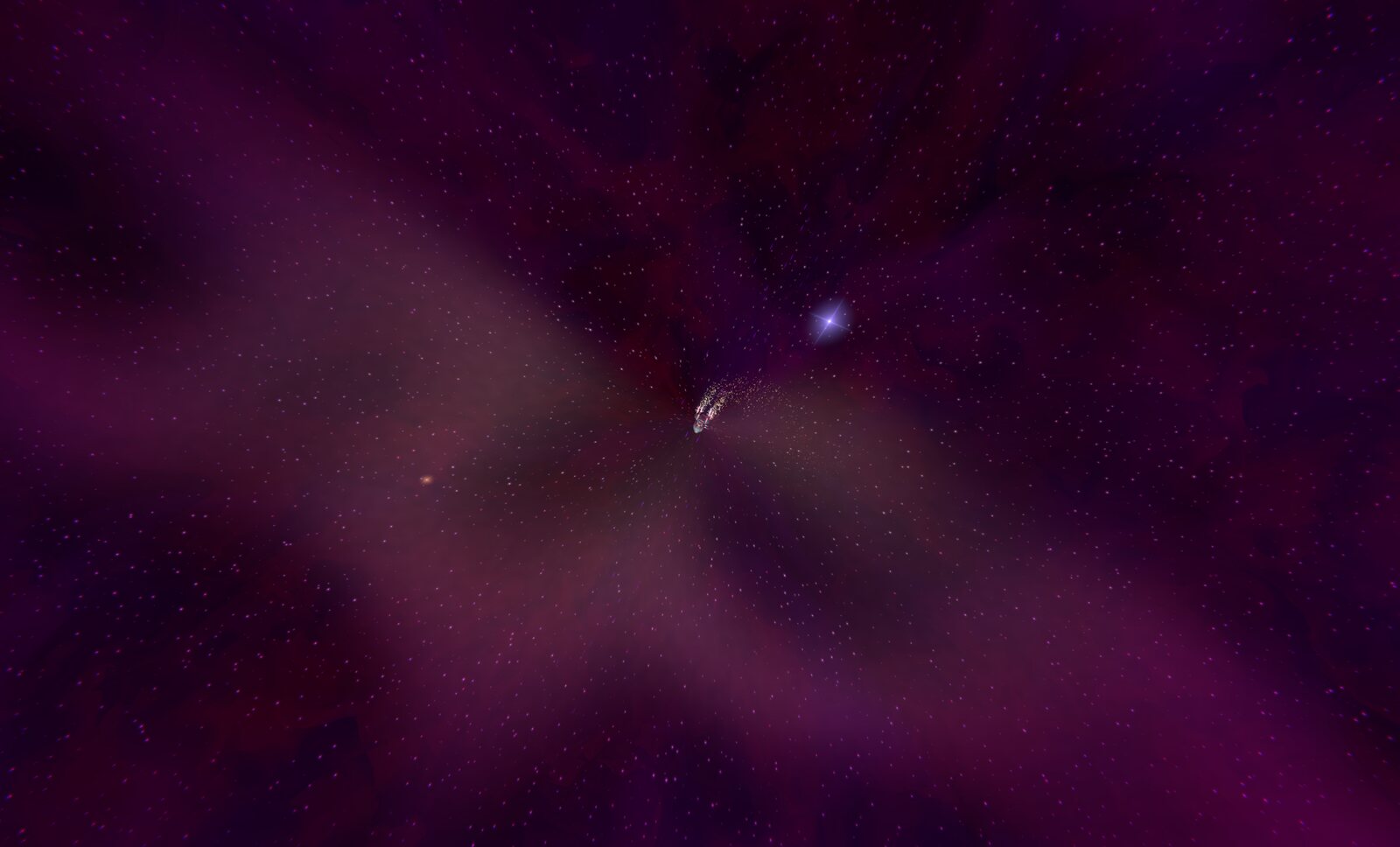
Captain one ship across seven faction ports while the people inside it cook, sleep, argue and keep the reactor running. Trade, salvage and fight to build a home that can survive the next passage. Every 7.3 days, the system stops behaving like itself.
You captain a single ship beneath a sky that went quiet centuries ago. Both of the game’s linked views are top-down and 2D. Outside the hull you fly, trade and fight across live orbits. Inside it, the people you recruited cook, sleep, argue and keep the ship alive. Everything described below is in the game right now.
Ship Life
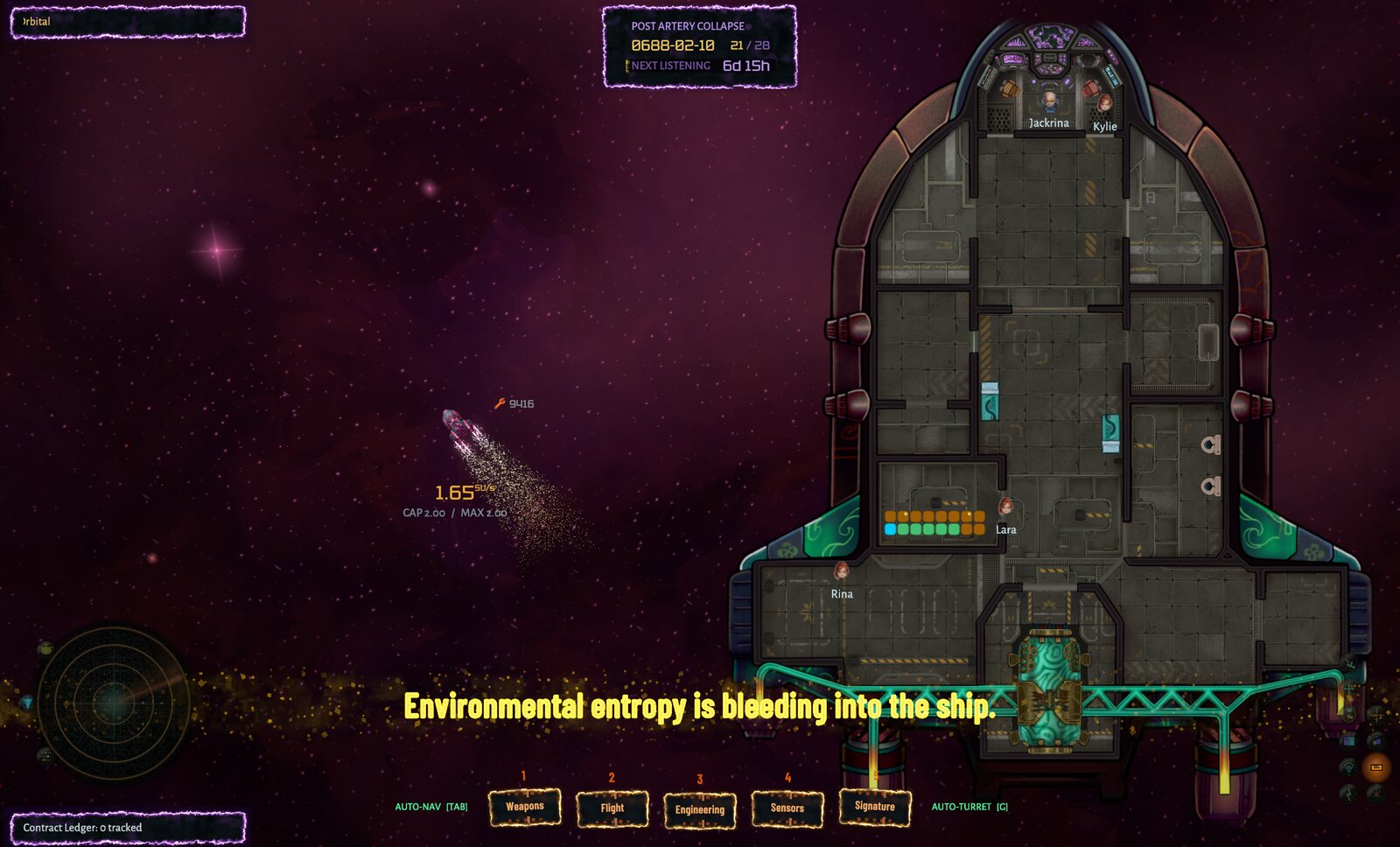
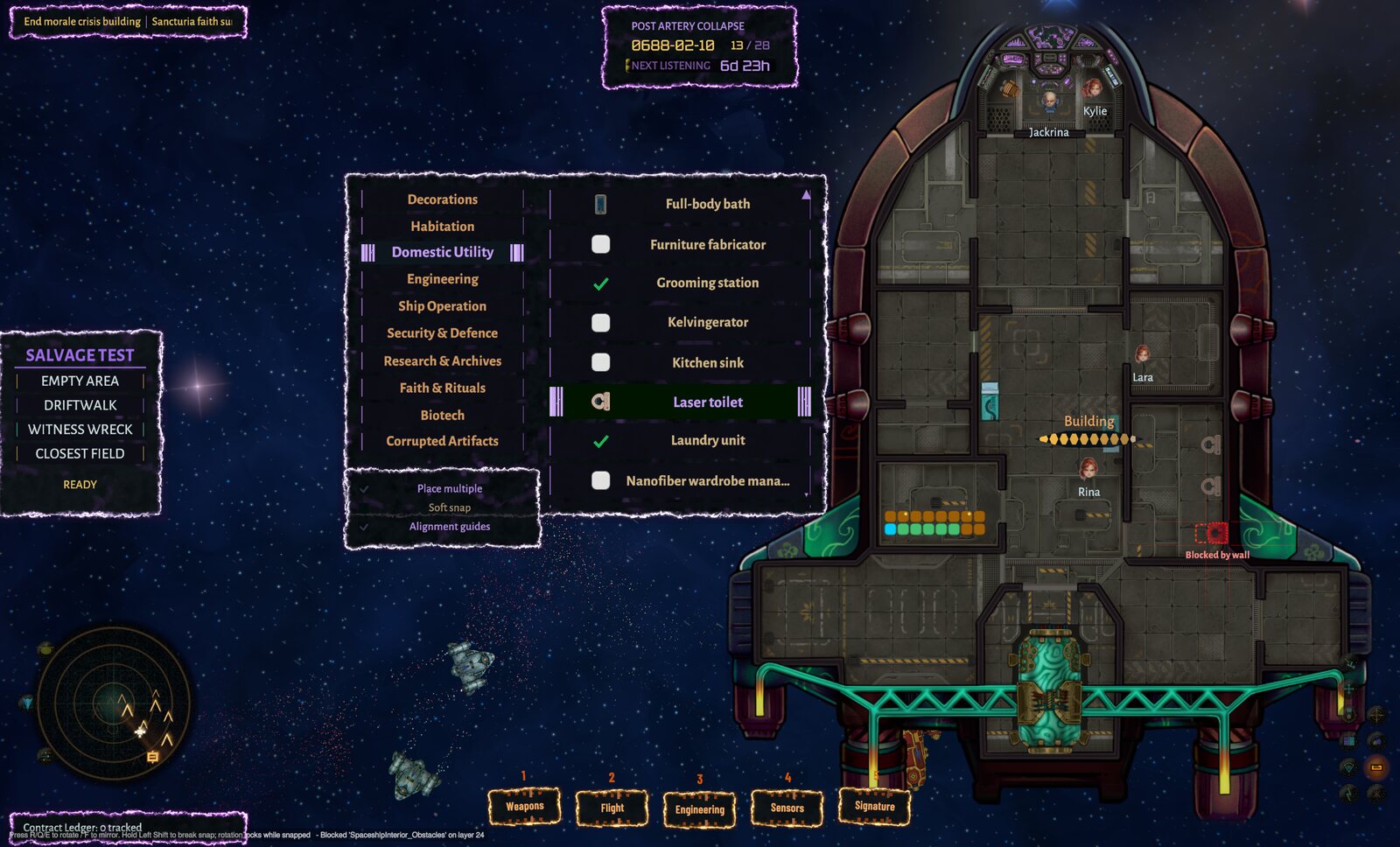
You furnish a free-form interior from a top-down 2D view: bunks, a galley, bathrooms, recreation, scanners and drone cradles arranged around the crew’s needs. Crew sleep in shifts, cook between watches, wash, unwind, and repair what entropy loosens. You set the work priorities and they handle the judgement calls in between. Skills grow with use, and each one lives inside a person you can lose.
Seven Ports, One Market
Goods flow between seven faction ports along three great lanes, priced by production, demand, and the memory of every recent trade. The other captains out there are all working an angle of their own: exporters feeding their home ports, chancers racing a rumour of shortage, relief crews hauling medicine at a loss because somebody has to. Beat them to a market and the margin is yours. Arrive behind a convoy and the price you planned around is already gone.
688 Years After the Artery
The Artery Stream once coupled this system to thousands of others. When it went quiet, nothing beyond the boundary answered again. That was 688 years ago. Seven factions have spent every year since building civilisations inside that silence, each one certain the others are coping with it wrong.
Signals in the Drift
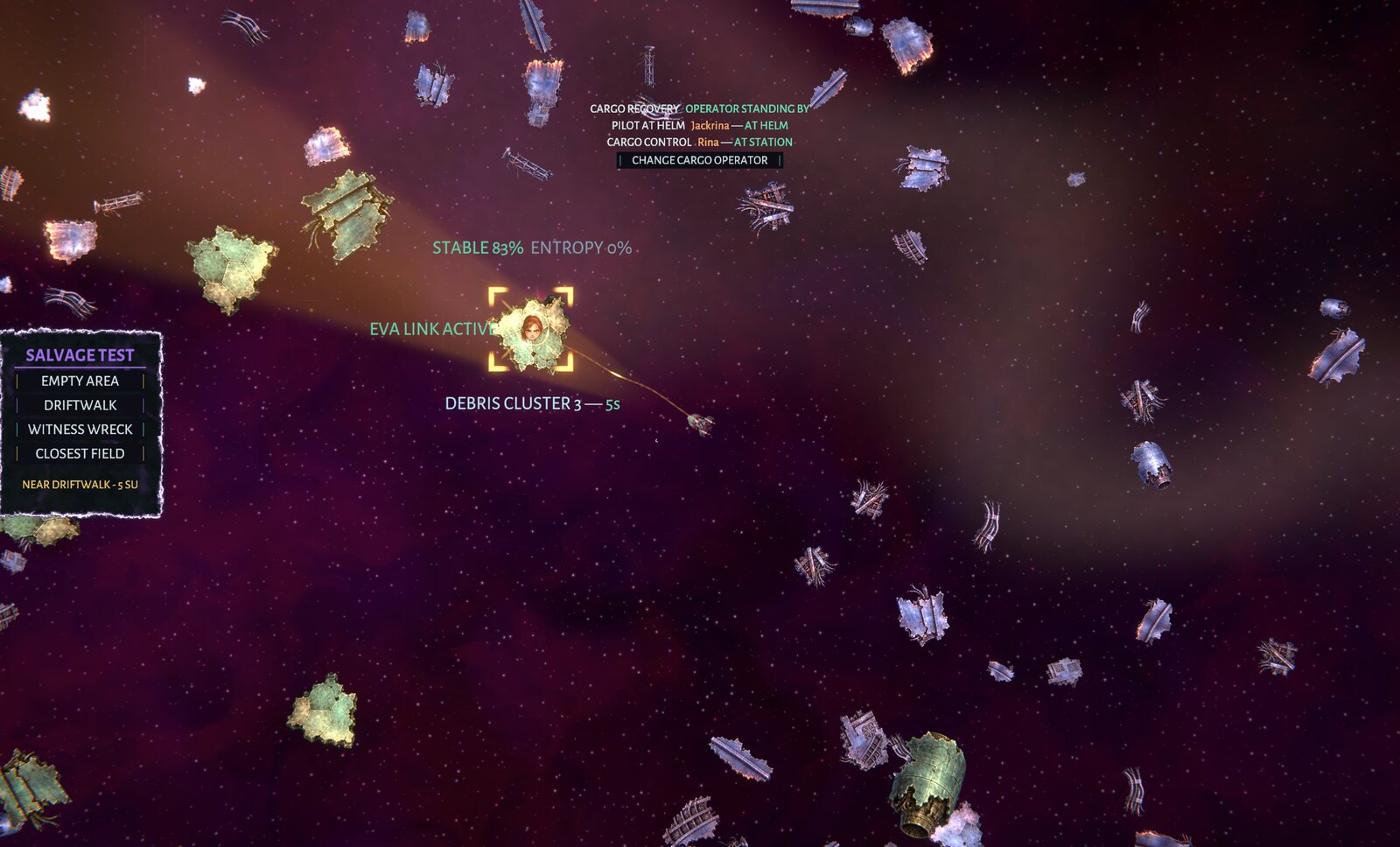
Dead ships still carry cargo, evidence, and sometimes people. Salvage takes a three-person EVA crew: a pilot holds the helm, a cargo operator waits at their station, and one specialist crosses the gap on a tether. A good haul pays for the whole trip. Every so often you come back with a survivor instead, or a question the wreck never answers.
CAPTAIN'S RECORD // OUTBOUNDTHE SHIP KEEPS THE TRUE VERSION
RED DRIFT / COURSE HELD
Outbound // Red DriftField recording
One Reactor, Every System
One reactor feeds everything, from the engines and turrets down to the galley stove, and when there is not enough power for all of it, you choose what stays warm. The ship also soaks up the places it has been. Fly the wrong stretches of space, haul the wrong cargo, let the cleaning slide, and a creeping wrongness settles into the corridors until you scrub it out or pay a station that knows how.
A Fight from the Captain’s Seat
Turrets do their own aiming, but somebody has to sit in the chair, and a tired gunner misses. A real fight is run from the captain’s seat: a shield raised at the right breath, a desperate jump out of a crossfire, drones snatching missiles off the hull, the whole battle laid out at a glance when it gets too fast to follow. Pirates circle, feint and adapt. Losing people is permanent.
The Listening
Every 7.3 days, the system-wide surge called the Listening makes ordinary work unreliable. Reactor output wavers, drones abandon their tasks, cargo records change and nearby ships sometimes turn hostile. Some failures vanish with the surge. The damage and missing cargo do not.
The Log Outlives the Crew
Seven factions keep seven separate opinions of you. Sink a wanted pirate and the credit lands on your name; haul food into a starving port and that market remembers who fed it. The news tells the public version of events. Your ship’s own log keeps the truer one, including the names of the people who are no longer aboard.
Sunfarers live aboard. The ship carries cargo, crew, and whatever routines keep them human between ports. You arrange its furniture, assign its stations, refit its working interior, and somewhere in all those hours underway it quietly becomes an address.
FIELD MANUAL // LIVE
The Manual Reads the Hull
The onboard manual reads the ship as it is: current controls, cargo, crew, hazards and assignments. No stale instructions. No separate abstraction from the home you are trying to keep alive.
10 linked systems01 shared reactorFREE layout
HULL / OCCUPIEDHOME IS A SYSTEM STATE
Interior refit // Domestic utilityLive feed
One hull. Interlocking systems.
Build around the crew
◇
Bridge
One seat, one view, and every heading decision between here and the next port.
Plot courses or take manual control
Momentum flight and threshold passage control
Comms for hails and contracts
✦
Weapons Bay
Turrets calculate the intercept. A crewed station decides whether the shot happens.
Manual batteries or predictive fire
Heavy combat abilities
Warp interdiction array
◎
Engineering
Everything aboard draws from the same reactor lattice, and entropy enters the circuit without asking.
Balance output, capacitors and load shedding
Repair hull and damaged systems
Power shields and repair drones
▣
Cargo Hold
Every load has weight, provenance, a market and at least one faction interested in it.
Cargo visibly fills the hold
Recover drifting pods
Customs, contraband and reserved contracts
◈
Crew Quarters
Rest compounds. A crew member who sleeps well recovers fatigue and works with steadier hands.
Bunks and sleep quality
Poor sleep leaves a lasting penalty
Rest and morale feed into Focus
◆
Mess Hall
Hot meals cost time and attention. They also keep a crew functional on the long runs.
Cooked meals restore morale
Shared meals reinforce cohesion
Food quality affects focus
◑
Recreation
Recreation stations restore morale and sanity between shifts.
VR pods, meditation and music
Shared games, lounges and bars
Diminishing returns reward variety
◎
Drone Bay
Some drones clean the corridors. Others leave the hull under fire to keep it intact.
Interior cleaning routines
External repairs using hull scrap
Sentinels intercept incoming fire
■
Interior Life
Crew walk the corridors, sit their stations, break for meals and make the layout a routine.
Direct crew with a click
Visible autonomous schedules
Priorities guide self-selected work
▲
Refit
The layout is the upgrade. Place what is missing and the crew build it from reserved materials.
Place, move and deconstruct furniture
Furniture shares the reactor lattice
Every new station creates new work
03
Flight & Astrogation
Navigation & Propulsion
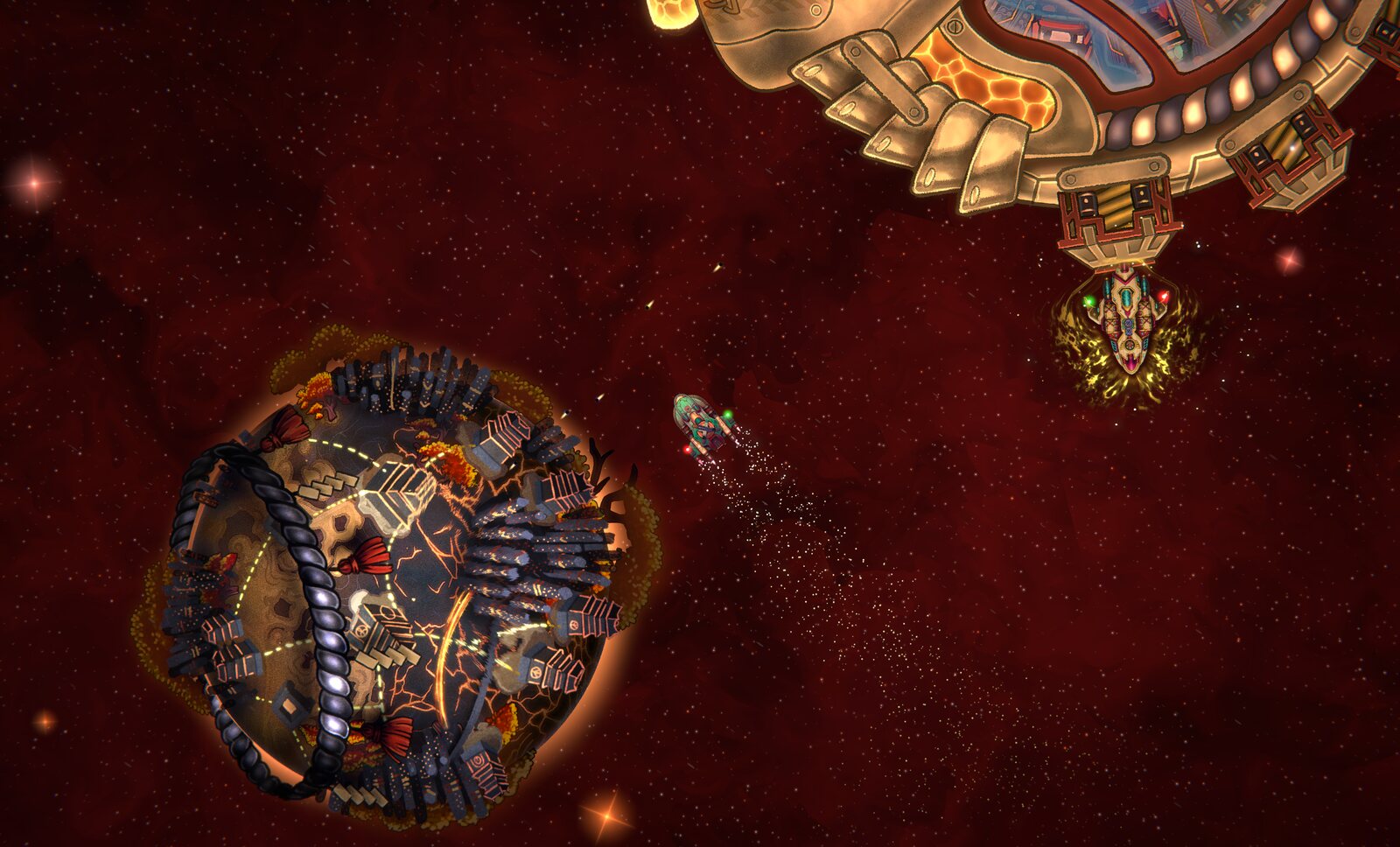
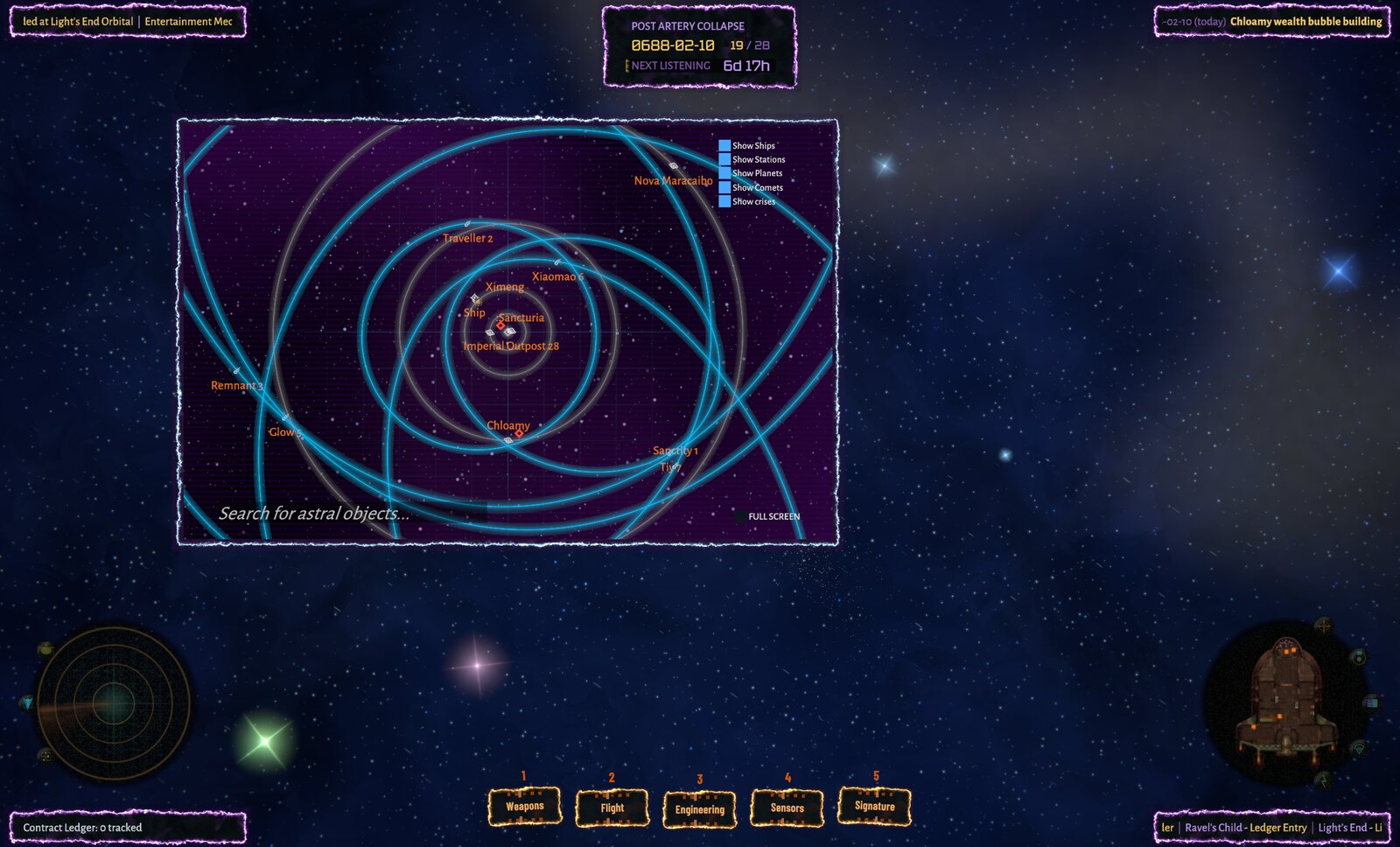
Six planets, an inhabited moon and a freeport station orbit a single star in a system bounded by silence. Between them: three main trade lanes, patrol corridors, a contested asteroid belt, debris fields, and the long empty stretches where the only company is whatever your sensors think they’re picking up.
07 faction ports03 great lanes01 uncrossed wall
ASTROGRAPH // LIVE ORBITSTRAJECTORIES ARE ADVISORY
Drift and Thrust
Momentum-based flight. Your ship carries its velocity: thrust forward, cut engines, drift. The nav computer plots acceleration curves, cruise phases, deceleration burns, and orbital approaches. Take manual control and that calculus is yours. The system is vast enough that patience, braking distance and momentum management matter as much as raw thrust.
Astral chart // Seven orbitsNav console
Passage Residue
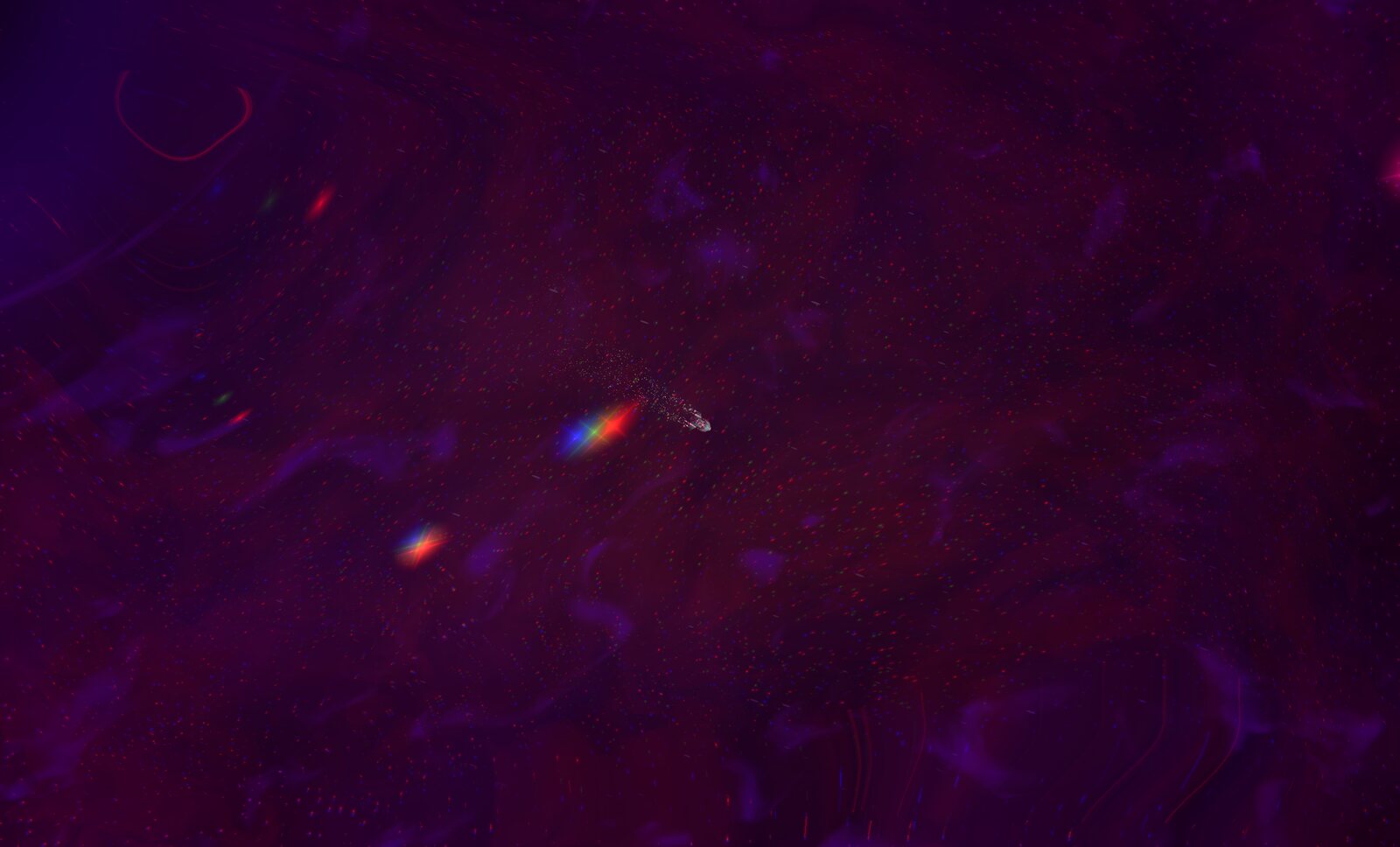
The entropic drive compresses long crossings. But the passage leaves its residue: voices in frequencies that shouldn’t carry sound, a lingering unease that doesn’t fade immediately after arrival. A sharp, rested crew brings the drive up quicker and rides it faster than an exhausted one, and the operators who sit closest to the coupling pay for the trip in corruption unless somebody buys a purification.
The Artery Stream once connected thousands of star systems. Ships coupled to the entrance and were swept along “like a bead of water racing down a crack in glass.” One day it hummed. The next, silence. Ships in transit didn’t arrive. Now this one system listens to static where voices used to be.Pre-Collapse records
Threshold passage // Residue visibleHull camera
The Queue
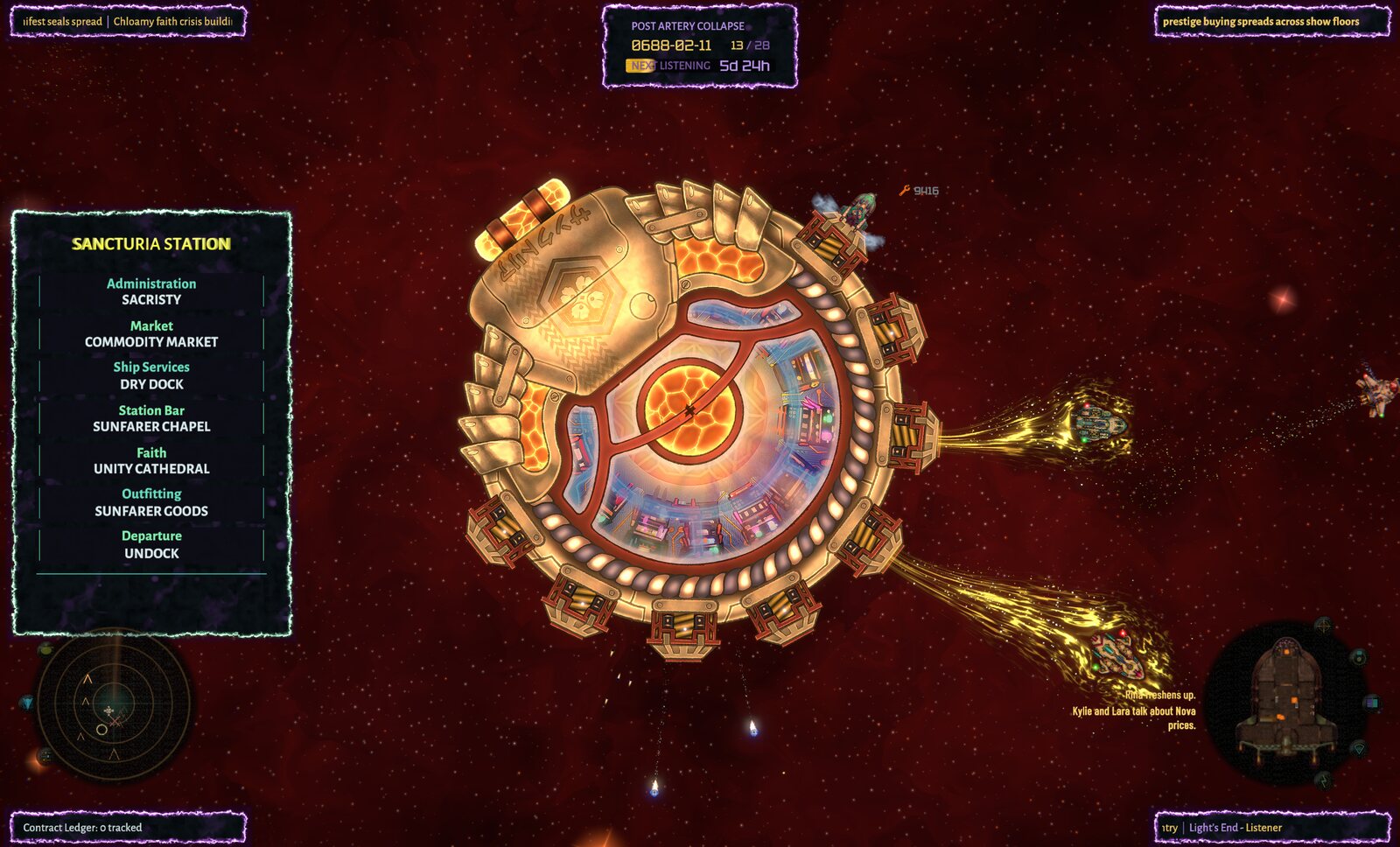
Stations have limited docking bays. Approach, queue, orbit while you wait. Merchant haulers circle alongside you, some loaded with Ximeng machinery, others running medical supplies to Sancturia. Sancturian purifier squads hold formation nearby between anomaly sweeps, and Ximeng insists on its inspections. Pirates idle at the edge of sensor range. Civilian transports carry passengers between worlds, and the berth you want is behind all of them. Expect to wait your turn.
The Wall
At the system’s edge, range finders return contradictory distances and the plotted boundary shifts between readings. Ships that cross it broadcast increasingly incoherent transmissions or go silent entirely. None has returned. Captains turn back because navigation stops producing a route anyone aboard can agree is real.
Space takes on texture near the boundary. The dark is almost the right shade but slightly off. Geometry distorts at angles that shouldn’t exist. Every probe sent past the threshold has returned data that contradicts itself, or hasn’t returned at all.Ximeng boundary survey
05
Recovery Operations
Debris-Field Salvage
Deep space is full of things that never reached port. A powered deep-space scanner can find their traces. A close helm survey tells you where the recoverable sections are. Everything after that requires three people, steady hands, and a ship kept close enough to keep the tether safe.
UNVERIFIED TRACE // 04-771HELM SURVEY
TRACEUNRESOLVED
PILOTREQUIRED
WATCHLINENO FIX
CONTENTSUNKNOWN
> SNOAS: Trace acknowledged. Seat a Pilot and bring the ship within survey range.
PilotHolds the helm through EVA
EVACrosses the empty distance
CargoBrings the recovery aboard
Find the Dead
Search deep space with a powered scanner or buy a dossier from a drydock. Wreck clusters and scattered driftwalks remain uncertain until you fly close and put a Pilot on the helm scanner.
Send Three
Choose a Pilot, an EVA specialist, and a Cargo operator. They leave ordinary work and assemble at their stations. The operation waits for all three; replace one, and you are trusting a different pair of hands out there.
Bring Back Proof
The recovery comes back as a real cargo pod drifting loose in the field, still marked with the wreck it was cut from. Scoop it, sell it, satisfy the contract, or lose it in the dark.
Witness Wrecks Need a Watchline
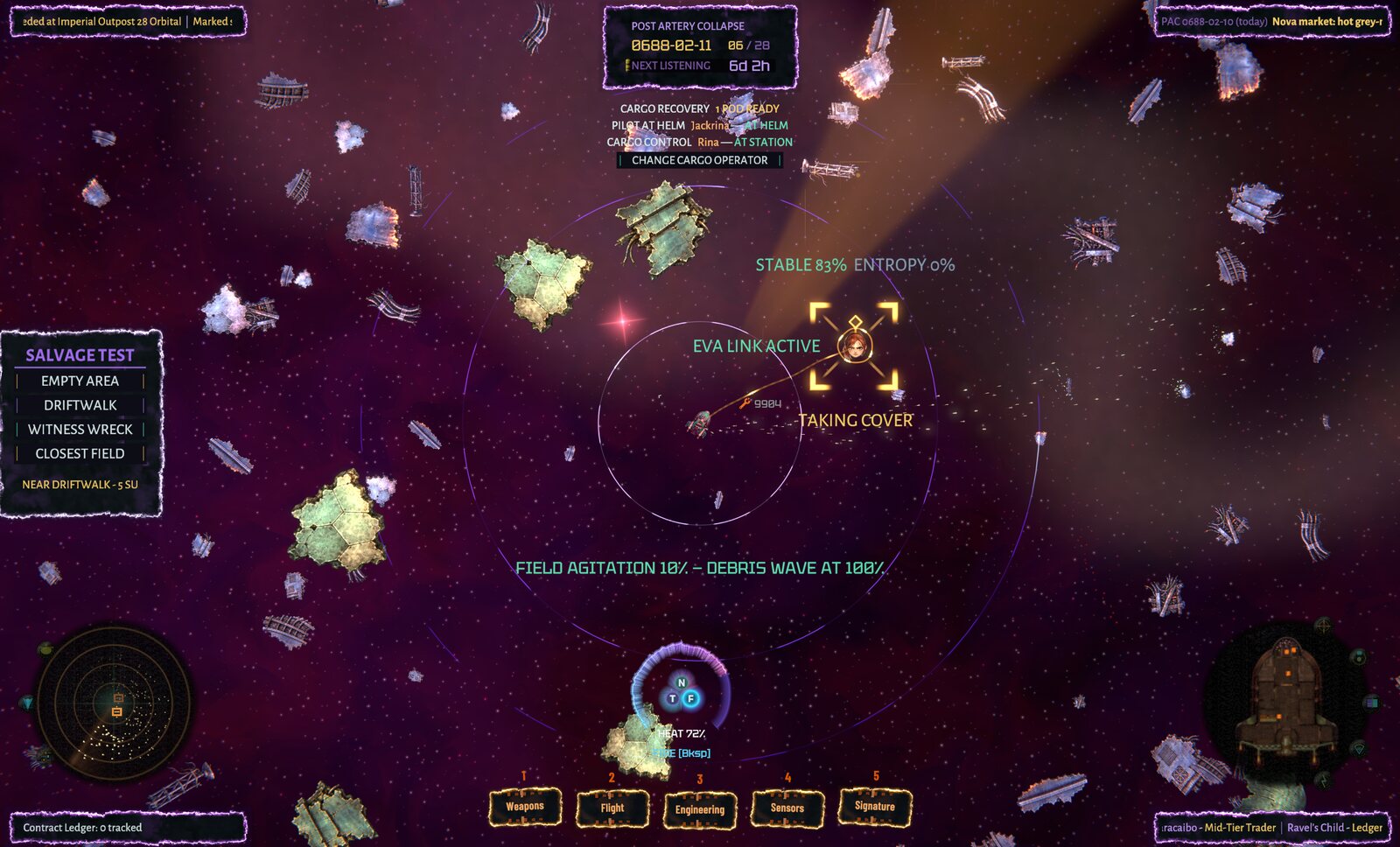
Once the specialist reaches the first section of a witness wreck, the Pilot has to stay seated and hold range, view cone, visibility arc, and a clear watchline. Driftwalks do not use that viewing rule; their scattered fragments leave the EVA exposed to ordinary field hazards instead. How you fly stays your call. Drift too far and the tether becomes lethal. Point the main thrusters the wrong way and the exhaust plume can hurt the person you sent out.
EVA link active // Debris cluster 3Recovery feed
The Field Pushes Back
Careful extraction takes longer and keeps the field calm; go in forceful and the work speeds up while the pressure climbs. Thresholds launch directional debris waves that threaten crew, pods, shields, and rivals. During the Listening, a witness wreck’s viewing cone can tighten and manual controls may invert, but the impossible conditions can leave more material intact.
Taking cover // Debris wave inboundHold the watchline
Someone Else Has a Claim
Rival salvagers arrive with their own contracts and their own idea of ownership. An extortion rival may take a payoff; others can turn hostile or make for the named cache. Rarely, the wreck still holds a previous salvager: recruit them, carry them home as a passenger, hand them to a rescue network, or make a harder call that will follow your ship around.
04
Markets & Manifests
Trade & Economy
Seven economies bound by necessity. Heavy industry and medicine from Ximeng, refined metals and religious goods from Sancturia, prototype components from IO-28, luxury and entertainment from Chloamy, storm-harvested energy cells from Ravel’s Child, corrupted scrap from Light’s End. Every commodity has producers, consumers, stock and legality patterns behind it, and a price that shifts with the system’s mood.
PRACTICE LEDGER // SIM 07DOCKED: XIMENG ORBITAL
PULSES500
HOLD0 / 12
NET±0
> SNOAS: Practice ledger open. Five hundred pulses, twelve units of hold. Show me a margin.
A Market with a Memory
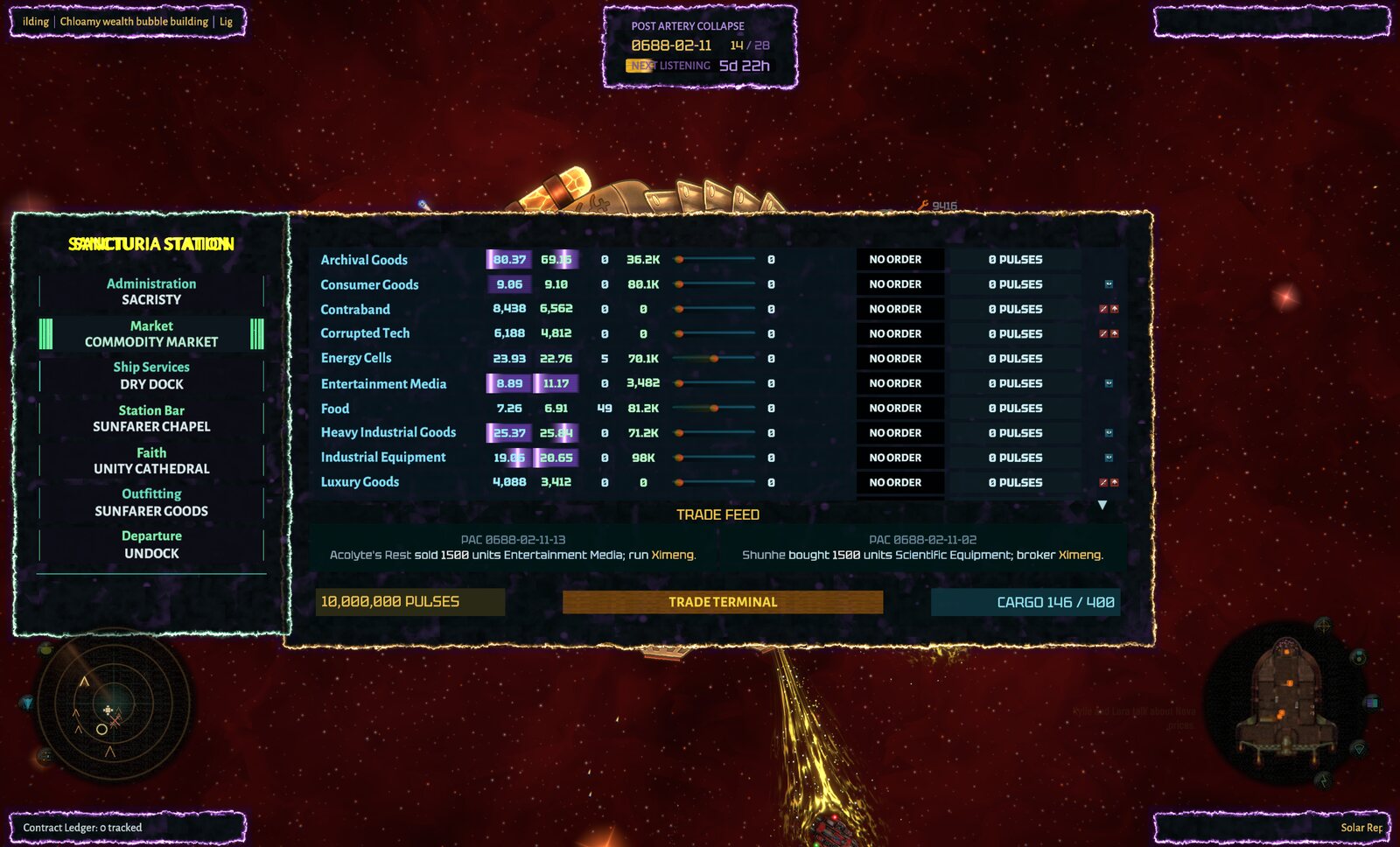
Prices follow supply and demand, and they remember. What costs twelve pulses at the refinery costs forty at the station running short. Production cycles shift with planetary conditions: morale, infrastructure decay, entropy surges. When a crisis hits, prices reshape which routes are worth flying.
Traffic Moves the Price
Autonomous traders fly the same lanes you do. Merchant haulers squeeze their margins, faction exporters feed their own worlds first, opportunists jump on every shortage bulletin, and a few humanitarians haul relief no matter what it pays. Their cargo moves prices exactly the way yours does, which means the market you plotted a course for is rarely the one you arrive at.
Contraband Changes at the Border
What Sancturia consecrates, Chloamy auctions. Each faction draws legal lines around specific goods: narcotics, weapons, corrupted tech, contraband. Cross a border with something undeclared in the manifest and customs patrols interdict, inspect, confiscate, then stack tariffs on whatever survives the search. Smuggler routes exist for those willing to trade legality for margin.
The Spiral Bazaar
Nova Maracaibo’s market occupies the system’s only neutral ground: a station carved from an old Artery node. The Spiral Bazaar rises in tiers, every faction trading openly under the Accords. Cargo from all seven faction ports changes hands here. Pirates operate from Maracaibo’s margins too, hunting trade routes between stations, interdicting cargo haulers, and selling looted goods back through the very bazaars their victims were heading toward. Violence inside the station is bad for business, so the lanes outside absorb it instead.
Step off the docking gantry and the noise hits first. A hundred negotiations in a dozen languages, cargo handlers shouting tier numbers, someone frying food that smells like three different planets. Nova Maracaibo doesn’t sleep. It just changes shift.Maracaibo port records
Commodity market // Sancturia terminalDocked
Shortage, Relief, Opportunity
Planetary incidents, shortages and entropy pressure disrupt supply chains. Stock loss, production penalties and temporary market policies push prices and delivery incentives around the system. Humanitarian traders accept losses to run relief routes; others wait for prices to peak. Your deliveries change local stock and can fulfil relief contracts, but one cargo run does not automatically stabilise a whole market.
06
Weapons Control
Weapons & Combat
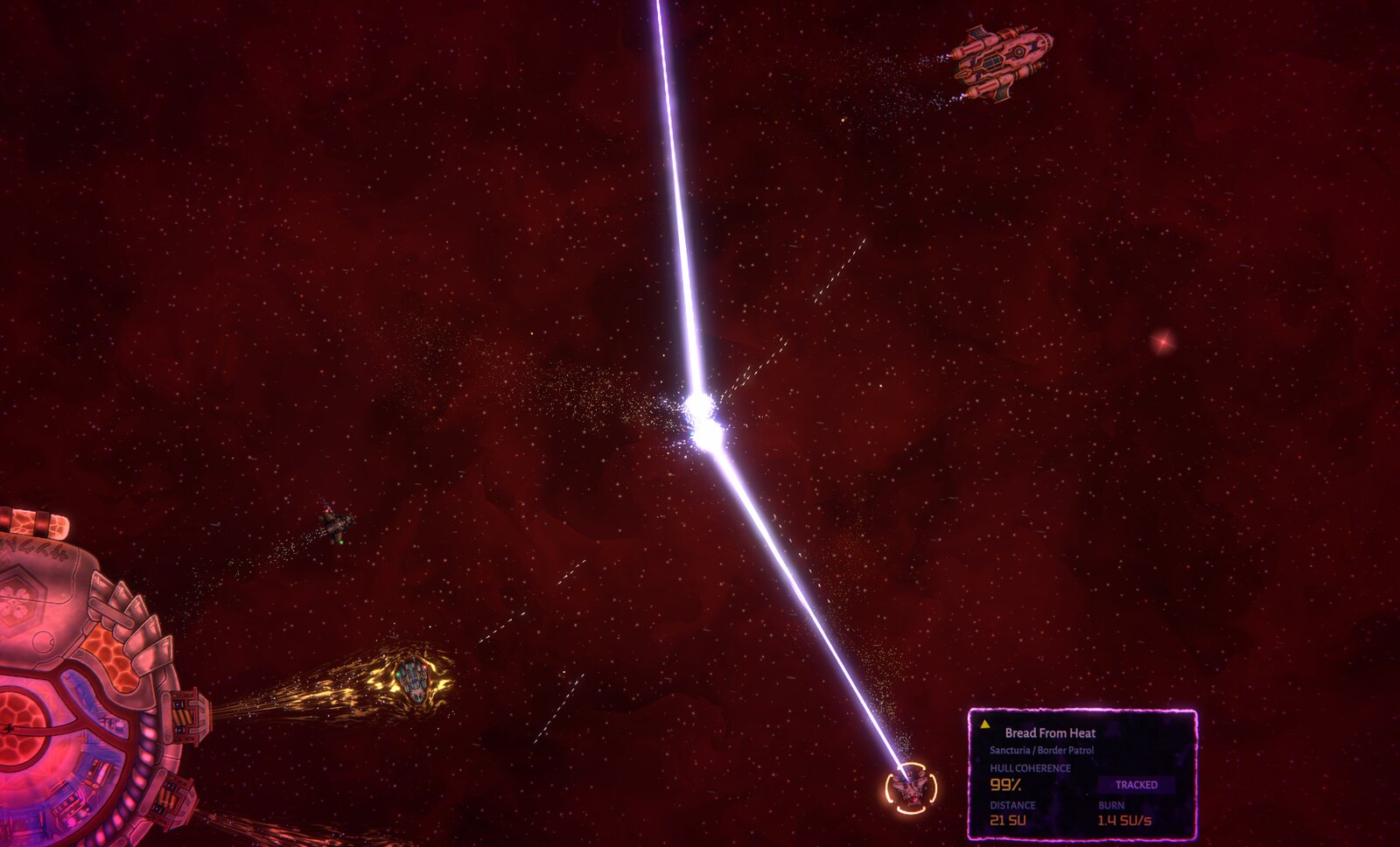
Combat is personal. Someone sits in the turret chair. Someone else keeps the engines running while the hull takes hits. The turrets handle the intercept math; whether the shot lands depends on who is in the seat.
Hands on the Guns
Turrets calculate intercept trajectories. But someone has to sit in the chair. A rested gunner reads the lead, compensates, lands the shot. An exhausted one watches rounds sail past the hull. The math is the same. The hands are different. Multiple turret stations let you mount a broadside, if you have the crew to staff them. Request direct control and every ready barrel follows your aim; if the seat is empty, the order waits while someone runs to take it.
Beam engagement // Contact trackedGun camera
The Command Deck
Its abilities span weapons, flight, engineering, sensors, and signature control. What is actually ready depends on the moment: who can reach the right station, how the reactor is holding, how much strangeness the ship has soaked up, and whether the last use has finished echoing. A shield can save the hull, or an Entropic Slip can put it somewhere else entirely. And a Dead Letter leaves its target carrying a problem that outlives the missile.
WeaponsFocused BarrageREADY
WeaponsKinetic StormREADY
EngineeringShip ShieldCHARGED
FlightEntropic SlipCOOLING
SignatureDead LetterARMED
Pulled from the Fold
Ships in threshold space leave a wake. The interdiction array locks onto that signature, charges, and pulls the target back into real space. Freighters, patrol corvettes, pirates running with stolen cargo. The array takes time to charge, and the window is narrow. Miss it, and the target is through. The same applies to you: fly a trade lane near hostile space and listen for the charge whine that means someone else’s array has found your wake.
Crew begin seeing entropy before their physical eyes: warping geometry, colours that don’t belong. The wrongness becomes visible, audible, tactile. That’s when the gunner’s hands matter most.Combat medical records
Hull, Crew, Loadout
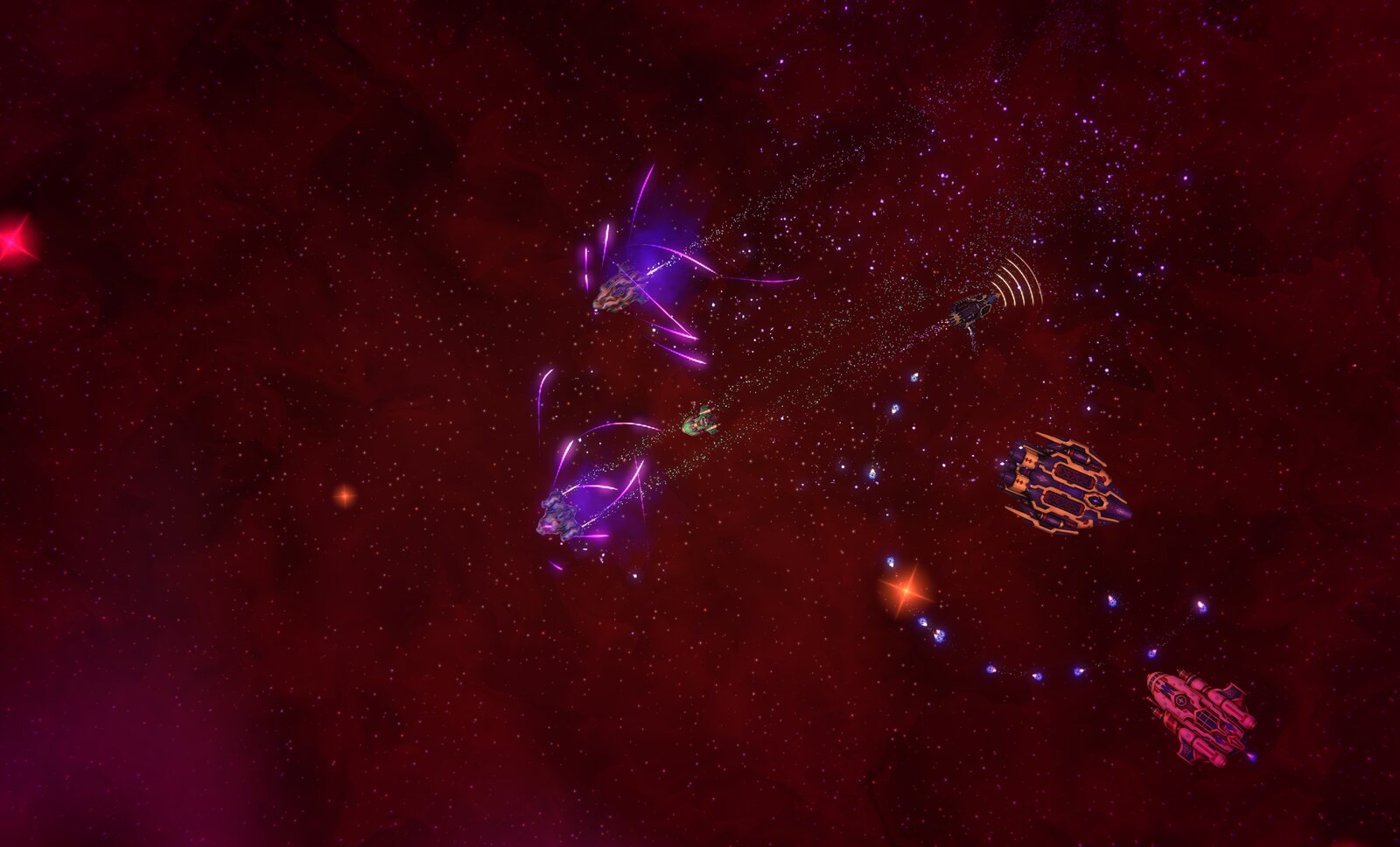
Other captains don’t line up and take turns. Their ships hold an orbit at range, joust through your firing arcs, kite away from your turrets, zigzag to spoil your lead, or lock into a steady track and trade fire. Their tactics can also shift as the hull gets thin, so an opening read stops being true halfway through the fight.
⟲
Orbit
⟶
Joust
➔
Kite
⤶
Zigzag
―
Steady Track
✶
Adapt
See the Shape of the Fight
Tactical View pulls the camera back without pausing the battle. Ships shrink to clean glyphs with heading, health and weapon reach drawn beside them, while missiles, beams and storm hazards stay live under your eye. It shows live local contacts and hazards within its tactical scope while the battle continues.
Light’s End ships are entropy-enhanced. Their geometry is unstable, their tech does things it shouldn’t. Matter that dissolves on contact, hulls that look hurt and eager. You cannot fight ships that break physics with conventional tactics.Fleet intelligence
Skirmish // Entropic weapons liveTactical feed
02
Personnel
Crew
Recruited from ports across the system, each with their own skills and history. Shared meals and close calls turn them into something like family. The personnel file has no field for that.
SUNFARER MUSTERVitals
DECK PRESENCE // LIVEWATCH 02
Hana Reyes
Repairing at Engineering · 84 focus
Signed on at Sancturia Station after her hauler was condemned. Keeps the coupling lattice tuned by ear.
> SNOAS ASSESSMENT: Reliable under load. Hums during threshold passages; cause unestablished.
Only the Duty tab is editable in play. Everything else is the ship telling you what it already knows.
Vitals Beyond Health
Health, fatigue, satiation, morale, sanity. Then the two the recruitment office keeps quiet about: entropy corruption, and where a person stands between Unity faith and entropy worship. Skills grow through use, from sunfaring to religious duties, and the whole tangle resolves into Focus, the single number that decides how well the work gets done.
Focus Under Pressure
Focus scales everything that matters under pressure: threshold transit speed, turret accuracy, repair rates, salvage recovery time. A crew member who slept in a proper bunk and ate a hot meal at a table outperforms one running on ration bars and four hours of rest. Faith sets the ceiling: Unity crews hold steady under a lower cap, while entropy-leaning crews run volatile and can spike higher.
A Crew Run Ragged
Push a crew member through back-to-back shifts and their Focus erodes. Meals get skipped, sleep cycles shrink, recreation keeps being postponed. The decline compounds: fatigue stacks, morale drops, and the engineer who held the coupling stable at 90% Focus can’t manage it at 40.
The Empty Bunk
When a crew member dies, they stay dead. Years of accumulated competence at the turret, the nav console and the drive coupling leave with them, and every loss narrows what your ship can do. Replacements wait at ports across the system, but the new face in the corridor isn’t the person who knew which valve to hit when the coupling whined at frequency three.
Priorities, Not Orders
Set work priorities and your crew figures out the rest. They walk to stations, sit down, do the work, break for food, find a bunk when they’re exhausted. If the hull takes damage during a meal, the engineer puts down the fork and runs.
Jian Yating deliberately extends her threshold transitions by twelve to fifteen seconds to hear harmonic patterns she describes as “music” rather than the voices most engineers report. Her colleagues think she’s brave. Her medical file says otherwise.Crew psych evaluation
Off watch // Entropy bleed containedInterior feed
08
Astrography
Worlds & Factions
One yellow dwarf. Six planets, one inhabited moon, one freeport station, and a contested asteroid belt. The Artery Stream once connected this system to thousands of others. When it fell silent, everything beyond the boundary stopped making sense. Seven factions survived, each with their own explanation for what happened and how to live with what followed. They built civilisations around those answers.
Inner system // Furnace orbitApproach camera
Select a faction
The Wall and the Belt
Between the inhabited worlds sits a contested asteroid belt: ore, ice, mining crews, and pirate berths hiding among legitimate operations. Beyond the outermost world sits the boundary, and past the boundary nothing comes back. Everything the seven factions have, they have because it was already inside when the Stream went quiet.
Once every 7.3 days, the whole of it tilts at once. That surge has its own page: .
Sancturia Station // ArrivalsDock queue
ARE YOU STILL THERE
09
Recurring Anomaly
The Listening
Every 7.3 days, entropy tightens across the whole system at once. Ximeng scientists have timed the recurrence precisely and can say nothing at all about why. Crews call it the Listening because that is exactly what it feels like: something out there, listening back.
RECURRENCE // 7.3 DAYSINPUT SOURCE: UNRESOLVED
CHANNEL 00SOMETHING IS RETURNING THE PING
The 7.3-Day Surge
Shadows thicken where nothing casts them. Sensors log readings that disagree with each other and with the hull. Matter blurs at the edge of attention, and the starfield can seem to breathe or pull toward the boundary in ways the instruments render but cannot account for. Crews report hearing their own names in voices that are almost right. Surges last from twelve to fifty-six in-world hours.
Nobody screams. That is the part that takes getting used to. Seven civilisations have had 688 years to build procedures around this, and every one of them has a form, a liturgy, a price curve, or a party ready for the next one.
The Listening // Sensor compositeSome readings are false
Seven responses to the same surge
Imperial Outpost 28Note it in the maintenance log. Keep working. The reactor gets its ceremonial pat either way.
SancturiaGather in the furnace-temples and chant the Litany of Angles until the rhythm outlasts the wrongness.
XimengSuspend permit processing. Records feel wrong during a surge, and a wrong record outlives the surge.
ChloamyThrow a party. Rooftop bars fill, the music goes loud, and somebody orders The Last Star.
Nova MaracaiboPrice it. The Spiral Bazaar reads surge disruption as a market signal and writes it into forward contracts.
Ravel’s ChildDouble-check every vault seal, verify containment, and wait it out with contractual patience.
Light’s EndConsider it sacred. Gather in silence. This is the closest they get to the thing they worship.
Aboard During a Surge
That is the folklore. Aboard a working ship, a surge is a stretch of hours where the vessel you know stops being entirely trustworthy: part of what happens is illusion that leaves when the surge does, and the rest is loss, change and damage you get to keep. Telling the two apart while it is still happening is the whole trick.
Instruments That Lie
A contact appears on the scanner and holds formation with you for an hour, though nothing ever shows in the window. A dot wanders the crew map through a compartment you can see is empty. The gauges quote a speed the ship is not flying. The hard part is that the helm still needs those instruments, so you decide, reading by reading, which ones to believe.
Machinery Off Pattern
The reactor’s steady note wavers, output sagging and spiking with no fault anyone can find. Turrets swing on their mounts while the guns stay quiet. A cleaning drone circles a patch of corridor it finished an hour ago, and once in a while an exterior drone simply lets go of the hull and drifts away, leaving a rebuild job where a working machine used to be.
The Extra Manifest Line
Mid-surge, the manifest gains a row flagged unverified, for a crate nobody remembers loading. Go and look: the bay might be empty, or holding exactly what the row claims. Cargo has come out of surges lighter, heavier, or changed into something else entirely, and the stations you trade with wrestle with the same problem at warehouse scale.
Crew Under Strain
A bad surge finds whoever is most worn down. Someone stops sleeping, or starts praying, or walks off their shift until the break passes and carries the shock afterward. And people see figures in the corridors wearing a crewmate’s face, gone before anyone else arrives. Whether a sighting like that steadies a person or breaks them depends on what they already believed.
The Lanes Turn Hostile
Entropy blooms swell in the dark while everyone’s sensors are busy lying. A planet’s mood curdles, its markets and its patience sagging together. Out on the lanes, ships that have passed each other peacefully for years pick fights nobody can explain afterwards.
SNOAS Holds Its Tone
SNOAS, your ship’s assistant, talks you through all of it in the same level tone it uses for docking clearances: surge reports, sensor contradictions, careful notes on the crew’s nerves. That composure almost always holds. Once in a great while it says something no assistant should say, then returns to business as if nothing happened.
Surge Severity
No two surges arrive the same size, and the long ones are the bad ones: a surge that lingers finds more to touch. Your first Listening will be gentle. Your second, uncomfortable at worst. After that, no promises.
MILDAtmospherePressure, strange light, a sky that will not sit still.
STANDARDDoubtInstruments start disagreeing. The manifest grows a row.
SEVEREConsequenceCrew break. Blooms grow. Cargo is really gone.
CATASTROPHICFull-System CascadeSeveral real and false failures overlapping across the system.
Three True Things
Long-haul crews turn a known surge window into labour. They mute the conversational machinery. They post human witnesses at hatchlines, mark the seals, copy positions onto paper, and compare what a screen says about the ship against the bulkhead under a hand. Nobody expects to prove the anomaly false. The aim is to keep enough shared, physical evidence in hand to make the next decision together.
This is why experienced crews distrust perfect agreement during a Listening. A clean diagnostic tree, a familiar voice, and a green status light are three observations, not three reassurances. The best account of a surge is usually the one assembled by people standing in different compartments using different senses.
Give the mind three true things: a door that shuts, a cup with weight, a person who answers in their own voice.Sister Aurelia Marchand, Sancturia cleansing hall
Work That Cannot Wait
Some work does not stop for a surge. On a witness wreck the viewing cone can tighten; in either kind of field, manual steering may invert while somebody is outside on a tether and the field grows less forgiving. The strange consolation is that fields worked during a surge give up more of their salvage intact. Whether that bargain justifies sending somebody outside is the sort of call captains argue about in station bars.
A rooftop bar trembles as a distant anomaly lashes a freight route. The patrons watch the news crawl for a minute, murmur about shipping costs, and go back to their drinks.Chloamy, during the Listening
Anchor Point Zero
Anchor Point Zero shrinks by 0.3 millimetres every 7.3 days, in step with the surge. Whether the two facts are connected is debated on Ximeng, denied on Sancturia, priced on Nova Maracaibo, and quietly worried about everywhere else. No faction has settled it, and neither will your instruments. All you have are readings, wreckage, and whatever your crew swears they heard.
Ximeng Customs can read your manifest alongside faction standing and active work. Trade and combat shape seven separate faction relationships; dialogue checks reputation, cargo, active quests and story flags.
CHRONICLE RELAY // TEXT RECOVERYRECORD 01 / VERIFIED
CAPTAIN'S CHRONICLEWORDS OUTLIVE THEIR SPEAKER
Third Engineer Yuki Moran signs off at 0600. “The hum's steady.” Corvin Tann marks the handover complete. Neither of them records what answered from inside the coupling.
STATEMENTMEMORYCONSEQUENCE
Faces on the Comms
Dialogue arrives two ways. Comms traffic between ships puts a face and a callsign on screen; narrative moments take over the middle of the display when the story earns it. The game pauses for both, because when somebody finally speaks out here, it tends to matter.
Dialogue Reads the Manifest
Dialogue branches on active quests and story flags, faction reputation, exact cargo and credits. The choices available are built from the state the ship can prove rather than a generic captain profile.
Faction Memory
Each faction tracks its relationship with you independently. Reputation changes market prices, can deny docking at hostile ports, and opens different dialogue. A captain who attacks Sancturian purifier ships finds fewer warm welcomes at their furnace-temples.
SNOAS Airwaves
Your ship’s assistant carries the system’s news wire, and its reports arrive sourced and bylined rather than narrated from on high. Incidents build, escalate, ease, and resolve. Opportunities open, fill, or pass, and the broadcast keeps moving whether you step in or not.
The Chronicle
Your ship keeps its own long memory: combat, cargo, contracts, enforcement, energy failures, salvage outcomes, and the stories that grow larger than the people who lived them.
Your Name Reaches Port First
Bounties follow attribution. Cargo you deliver appears on station shelves. Planetary incidents alter prices, production, enforcement, entropy pressure, and the contracts people are willing to offer. Salvage survivors remember whether you carried them home. SNOAS Airwaves tells the public version; the Chronicle keeps the version your ship lived through. Your reputation reaches the next port before you do.
Third Engineer Yuki Moran hands off to Second Engineer Corvin Tann at 0600, as she has every third morning for eleven years. “The hum’s steady.” Corvin makes the sign against entropy. Yuki asks if he wonders what spacers hear during the Listening. “I don’t wonder about things I can’t fix,” Corvin replies. The hatch seals, the reactor hums, and beyond the hull, the Wall eats the light of distant stars.Imperial Outpost 28
The soundscape follows what the ship is doing. Engines, weapons, impacts and docking cues live in world space; station radio reflects the factions speaking. The score moves between calm space, docked, combat, warp and the pressure of blooms or salvage.
WorldenginesScoregame stateRadiofactions
SNOAS // RESONANCE SCOPECHANNEL IDLE
ARCHIVE READYSELECT A RECORDING
FOUR SIGNALS IN LOCAL MEMORY
03.7 / 18.2HULL PICKUP
00:00--:--
FFT / 256 BANDSOUTPUT MUTEDBUS / MUSIC
The Mix Follows the Ship
Engine loops, weapons, impacts and station tractor beams are positional, so traffic and combat move around the listener. Docking adds berth cues and faction-aware radio. The score crossfades between calm space, docked, combat, warp and the pressure states used by entropy blooms and salvage.
LOCAL AMBIENCEHULL / QUIET
Long drift // Between portsAmbient mix
Four Signals from the Score
All music composed in-house. Select a recording to route it through the resonance scope.
01DRIFT
Nebula Drift
Exploration
The long passage between ports. Instruments trading phrases with silence, unhurried.
02CONTACT
First Contact
Combat
Contacts on sensors. The moment between identification and engagement.