After the stars went quiet.

SUNFARERS

A Space Life Simulator

Sunfarers

Sunfaring; a centuries-old profession between radiator heat and station neon. Fly the lanes, trade, explore, fight, pray that your ship doesn't whisper your name. If it does, purification rituals keep the unthinkable at bay. Build a sanctuary in space, a place of comfort in a universe that doesn't look quite right.

Ship Life

Your crew sleeps in shifts, cooks between watches, repairs what entropy loosens. The ship starts as transport. It becomes home through use.

A Breathing Star

Seven factions orbit a single star, trading energy cells and medical supplies, religious goods and contraband. The entropic drive gets you there fast. The passage leaves marks.

What Remains

The Artery Stream once connected this system to thousands of others. When it fell silent, the rest stopped answering. Seven factions, one star, and silence where voices used to be.

Your Ship

Sunfarers live aboard. The ship carries cargo, crew, and whatever routines keep them human between ports. You walk its corridors, assign its stations, upgrade its systems. Over time, it stops being a vessel and becomes something closer to a place.

Bridge
Weapons
Engine
Cargo
Quarters
Mess
Rec
Drones
Interior
Upgrades

    Navigation & Propulsion

    Seven worlds orbit a single star in a system bounded by silence. Between them: trade routes, patrol corridors, debris fields, and the long empty stretches where the only company is whatever your sensors think they’re picking up.

    Drift and Thrust

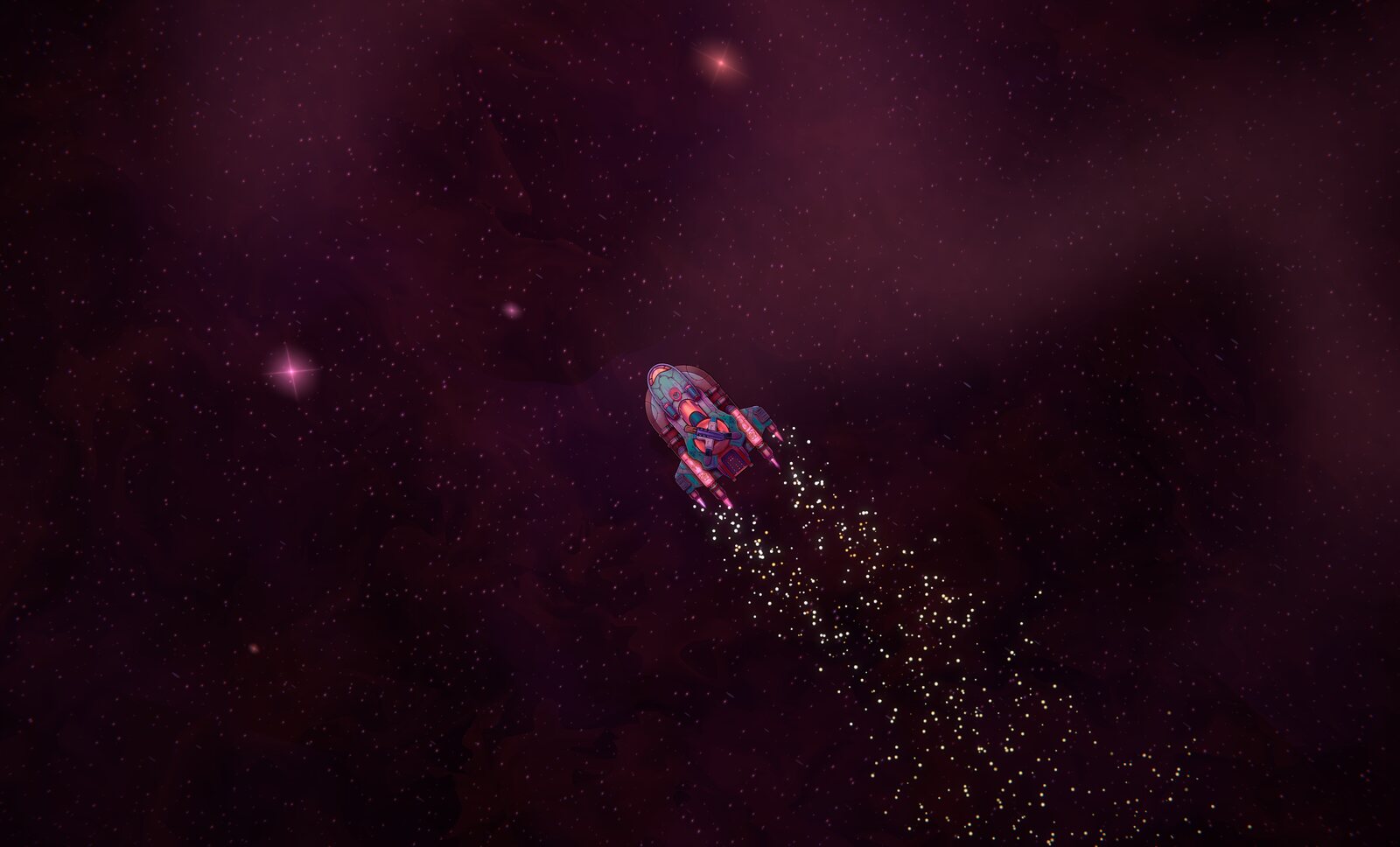
    Momentum-based flight. Your ship carries its velocity: thrust forward, cut engines, drift. The nav computer plots acceleration curves, cruise phases, deceleration burns, and orbital approaches. Take manual control and that calculus is yours. The system is vast enough that patience and fuel economy matter as much as raw thrust.

    What the Drive Costs

    The entropic drive folds space. Weeks of travel compress into hours. But the passage leaves its residue: voices in frequencies that shouldn’t carry sound, a lingering unease that doesn’t fade immediately after arrival. Crew focus governs transit speed; a sharp, rested crew pushes through faster than an exhausted one.

    The Artery Stream once connected thousands of star systems. Ships coupled to the entrance and were swept along “like a bead of water racing down a crack in glass.” One day it hummed. The next, silence. Ships in transit didn’t arrive. Now there is only this one system, listening to static where voices used to be.Pre-Collapse records

    The Queue

    Stations have limited docking bays. Approach, queue, orbit while you wait. Merchant haulers circle alongside you, some loaded with Ximeng steel, others running medical supplies to Sancturia. Sancturian purifier corvettes hold formation nearby, scanning for contraband. Privateers idle at the edge of sensor range. Civilian transports carry passengers between worlds. The system runs on traffic, and every berth has a queue.

    The Wall

    At the system’s edge, where reality thins: instruments begin to disagree with each other. Range finders return contradictory numbers. Crew report hearing their own names spoken in almost-familiar voices. The stars ahead shine in colors that don’t correspond to any known spectrum. Ships that cross the boundary broadcast increasingly incoherent transmissions, or go silent entirely. None return. The system is finite, and the boundary is not a metaphor.

    Space takes on texture near the boundary. The dark is almost the right shade but slightly off. Geometry distorts at angles that shouldn’t exist. Every probe sent past the threshold has returned data that contradicts itself, or hasn’t returned at all.Ximeng boundary survey

    Trade & Economy

    Seven economies bound by necessity. Refined materials from Ximeng, religious goods from Sancturia, prototype components from IO-28, luxury goods from Chloamy. Twenty commodities circulate through the system, each with a supply chain, a faction that controls it, and a price that shifts with the system’s mood.

    The Price of Distance

    Prices follow supply, demand, and the memory of every recent trade. What costs twelve pulses at the refinery costs forty at the station running short. Production cycles shift with planetary conditions: morale, infrastructure decay, entropy surges. When a crisis hits, prices reshape which routes are worth flying.

    The Routes Are Crowded

    Autonomous traders fly the same lanes you do. Merchant haulers optimizing margins, faction-aligned exporters prioritizing their own worlds, opportunists chasing shortage alerts, humanitarians running relief goods at a loss. When half the fleet arrives at Ximeng carrying refined materials, the quoted price has already adjusted before you dock.

    What’s Sacred, What’s Sold

    What Sancturia consecrates, Chloamy auctions. Each faction draws legal lines around specific goods: narcotics, weapons, corrupted tech, contraband. Cross a border with the undeclared manifest and customs patrols interdict, inspect, confiscate. Tariffs stack. Smuggler routes exist for those willing to trade legality for margin.

    The Spiral Bazaar

    Nova Maracaibo’s market occupies the system’s only neutral ground: a station carved from an old Artery node. The Spiral Bazaar rises in tiers, every faction trading openly under the Accords. Cargo from all seven worlds changes hands here. Pirates operate from Maracaibo’s margins too, hunting trade routes between stations, interdicting cargo haulers, and selling looted goods back through the very bazaars their victims were heading toward. Violence inside the station is bad for business. Outside, the lanes tell a different story.

    Step off the docking gantry and the noise hits first. A hundred negotiations in a dozen languages, cargo handlers shouting tier numbers, someone frying food that smells like three different planets. Nova Maracaibo doesn’t sleep. It just changes shift.Maracaibo port records

    Crises and Incentives

    Entropy blooms disrupt supply chains. A surge near Sancturia damages agricultural infrastructure; food prices spike, morale drops, and the cascading effects ripple outward through connected trade routes. The system generates delivery incentives: premium contracts for hauling relief goods where they’re needed most. Humanitarian traders accept losses to run those routes. Others wait for prices to peak. Your choice shapes which stations recover and which ones spiral.

    Weapons & Combat

    Combat is personal. Someone sits in the turret chair. Someone else keeps the engines running while the hull takes hits. The math is predictive targeting and intercept trajectories. The variable is the crew behind it.

    Hands on the Guns

    Turrets calculate intercept trajectories. But someone has to sit in the chair. A rested gunner reads the lead, compensates, lands the shot. An exhausted one watches rounds sail past the hull. The math is the same. The hands are different. Multiple turret stations let you mount a broadside, if you have the crew to staff them.

    Pulled from the Fold

    Ships in threshold space leave a wake. The interdiction array locks onto that signature, charges, and pulls the target back into real space. Freighters, patrol corvettes, pirates running with stolen cargo. The array takes time to charge, and the window is narrow. Miss it, and the target is through. The same applies to you: fly a trade lane near hostile space and listen for the charge whine that means someone else’s array has found your wake.

    Crew begin seeing entropy before their physical eyes: warping geometry, colors that don’t belong. The wrongness becomes visible, audible, tactile. That’s when the gunner’s hands matter most.Combat medical records

    Every Ship Fights Differently

    NPC ships don’t line up and take turns. They orbit at range, joust through your firing arcs, kite away from your turrets, break and evade when the hull gets thin, or adapt their approach mid-engagement when they realize what you’re doing. Every encounter reads differently.

    Orbit
    Joust
    Kite
    Evade
    Adapt
    Light’s End ships are entropy-enhanced. Their geometry is unstable, their tech does things it shouldn’t. Matter that dissolves on contact, hulls that look hurt and eager. You cannot fight ships that break physics with conventional tactics.Fleet intelligence

    Crew

    Recruited from ports across the system, each with their own skills and history. They become found family over time. The bunk they sleep in, the station they work, the meals they share. Every one of them is irreplaceable in ways the personnel file doesn’t capture.

    Crew Dossier
    NAME Hana Reyes
    ROLE Pilot / Engineer
    FOCUS 73 / 100

    Health
    82
    Fatigue
    34
    Morale
    61
    Sanity
    91
    PilotingTiredWell-Fed

    What They Carry

    Health, fatigue, satiation, morale, sanity. Skills earned through use, from sunfaring to engineering. All of it feeds into Focus: the number that governs how well your crew does what you ask of them.

    The Multiplier

    Focus scales everything that matters under pressure. Warp speed, turret accuracy, repair rates. A crew member who slept in a proper bunk and ate a hot meal at a table will outperform one running on ration bars and four hours of rest.

    The Cost of Running Lean

    Push a crew member through back-to-back shifts and their focus erodes. Skip meals, shorten sleep cycles, postpone shore leave. The decline is gradual until it isn’t: fatigue stacks, morale drops, and the engineer who held the coupling stable at 90% focus can’t manage it at 40.

    The Empty Bunk

    When a crew member dies, they stay dead. The skills they carried—years of accumulated competence at the turret, the nav console, the drive coupling—leave with them. Every loss narrows what your ship can do. Replacements wait at ports across the system, but the new face in the corridor isn’t the person who knew which valve to hit when the coupling whined at frequency three.

    Autonomous Routines

    Set work priorities and your crew figures out the rest. They walk to stations, sit down, do the work, break for food, find a bunk when they’re exhausted. If the hull takes damage during a meal, the engineer puts down the fork and runs. You set the priorities. They make the judgment calls in between.

    Jian Yating deliberately extends her threshold transitions by twelve to fifteen seconds to hear harmonic patterns she describes as “music” rather than the voices most engineers report. Her colleagues think she’s brave. Her medical file says otherwise.Crew psych evaluation

    The System

    One star. Seven worlds. The Artery Stream once connected this system to thousands of others. When it fell silent, everything beyond the boundary stopped making sense. Seven factions survived, each with their own explanation for what happened and how to live with what followed. They built civilizations around those answers.

    The Listening

    Every 7.3 days, entropy effects intensify across the system. Shadows deepen where no object casts them. Sensors log readings that contradict each other. Matter blurs at the edges of perception. Crews report hearing their own names in almost-familiar voices. Duration: eleven minutes to six hours. Ximeng suspends permit processing. Sancturia chants the Litany of Angles. Chloamy throws parties. Light’s End celebrates. Everyone else waits it out.

    A rooftop bar trembles as a distant anomaly lashes a freight route. The patrons watch the news crawl for a minute, murmur about shipping costs, and go back to their drinks.Chloamy, during the Listening

    Dialogue & Narrative

    Every conversation carries weight. What you say at a Sancturian customs checkpoint shapes what gets offered at the next. Faction relationships shift with your choices, your trade history, your combat record. The system pays attention.

    Two Modes

    Dialogue presents in two forms: comms transmissions between ships, rendered as portrait and speaker identity; and narrative moments, rendered as centered text cards during significant story beats. Both pause the game. Both carry consequences.

    Conditions and Consequences

    Dialogue branches based on what you’ve done, who you’ve traded with, what you’re carrying. A captain known for running medical supplies to Sancturia during a crisis gets a different reception than one flagged for smuggling contraband through Ximeng customs.

    Faction Memory

    Each faction tracks its relationship with you independently. Reputation opens doors: better contracts, access to restricted goods, priority docking. A captain who interdicts Sancturian purifier ships finds fewer warm welcomes at their furnace-temples.

    The System Remembers

    Bounties follow attribution. Cargo you deliver appears on station shelves. Story flags persist across save files. The choices you make during crises, the factions you prioritize when supply chains collapse, the conversations you walk away from—all of it accumulates into a reputation that precedes you at every port.

    Third Engineer Yuki Moran hands off to Second Engineer Corvin Tann at 0600, as she has every third morning for eleven years. “The hum’s steady.” Corvin makes the sign against entropy. Yuki asks if he wonders what spacers hear during the Listening. “I don’t wonder about things I can’t fix,” Corvin replies. The hatch seals, the reactor hums, and beyond the hull, the Wall eats the light of distant stars.Imperial Outpost 28

    Soundscape

    Between worlds, the ship finds its own quiet: the reactor’s hum, air cycling through vents, a kettle heating in the mess. The soundtrack lives inside that quiet. Strings surface during the long drifts between ports. Percussion builds when contacts appear on sensors. And during threshold passages, something else entirely—the sound of space folding, and whatever resonates through the hull while it does.

    Every compartment carries its own ambient layer, proximity-gated and mixed in real time. Walk past engineering and hear the coupling lattice thrum. Pass through the mess and catch the low murmur of crew between shifts. The cargo hold echoes differently full than empty. These layers stack, overlap, and thin out as you move through the ship. The music responds to state: docked and loading, drifting between worlds, locked in combat, or passing through the fold where the drive’s voice drowns everything else out.

    From the Soundtrack

    All music composed in-house. Four pieces from the game.

    Nebula Drift
    Exploration

    The long passage between ports. Instruments trading phrases with silence, unhurried.

    First Contact
    Combat

    Contacts on sensors. The moment between identification and engagement.

    Port of Call
    Station

    Docked. Cargo shifting in the hold. Shore leave for whoever earned it. The station’s low hum beneath everything.

    The Listening
    Entropy

    Every 7.3 days, the system holds its breath. The ship grows quiet in ways the instruments can’t account for.

    ...it is quiet today.SNOAS, unprompted